

In 1998 Stuart King and I visited Romania to study traditional woodcrafts and particularly to visit the last flask turner Ion Constantin. I had heard about him a couple of years beforehand. in fact I went to the world turning conference in the USA where he was billed as attending only to find that they had not managed to sort out his travel and visa. Thankfully the organisers of the conference contributed to Stuart and myself traveling to Romania and photographing and videoing Mr Contantin at work. It was clear that he had not made these flasks for many years and the one he made was rather rough and thick walled compared to the delightful old ones, but I was able to see enough of the technique to work out how to make nice ones myself though I have not made any for a few years. Stuart has just put the video up on youtube so now everyone can see it.
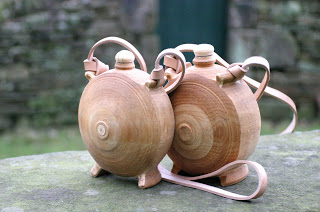
and here are some of the flasks I made based on a 15th century design.
On the same trip one of the highlights was this sawmill. It sat on a steep slope within the bend of a switchback on the road. Timber lorries unloaded by tipping the logs off above the mill then they moved down through the mill with gravity helping all the way before finished timber, sawdust and offcuts were all loaded onto waiting vehicles on the road at the bottom of the mill. Having run a far more advanced modern bandsawmill for the National Trust I was blown away by the efficiency of this set up and asked Stuart to film it. At first the cutting speed appears fairly slow until you realise that it is cutting the whole log into multiple planks and it never stops, as one log comes out another is fed in.


wauw! those flasks are amazing..!!
Very interesting – immediately put me in mind of Serbian plum brandy, Navip Slivovitz, that is bottled in a flask evocative of the wooden ones.Slivovitz (in the US we call it moonshine) is an interesting experience but one that I haven't had a desire to repeat for many years.
The flasks are part of traditional dress and are apparently brought out for weddings filled with tsuika (not sure how it is spelled but it is plum brandy like slivovits)
Wonderful videos, thanks for posting. I am sure I will be watching them many times. I have to adapt my lathe so I to can sit and turn!
Great post, thank you. This was well worth seeing. I don't want to seem greedy, but any more of this sort of thing would be very much appreciated!Regards.
Amazing. The whole setting – the lathe, the methods, the chicken, everyone helping somehow – isn't far from the medieval, somehow. Great.
Ineteresting Robin, how do you keep the seal with the warping as it dries?
Also it looks like the sawmill is using a sash saw is that correct?
Hi Graeme,
It keeps watertight as it dries if you understand the shrinkage. The plug tends to be cut from radially cleft wood which shrinks less so generates a little pressure and helps the seal. The sawmill is a racksaw.
Thanks Robin,
Appreciated.
Graeme