


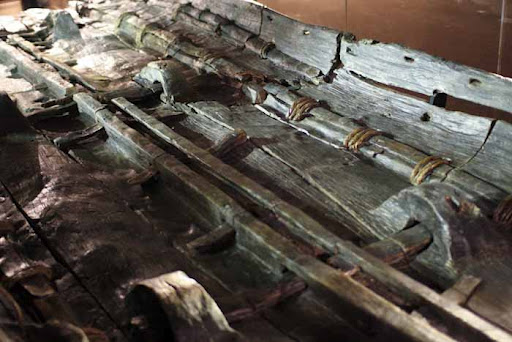
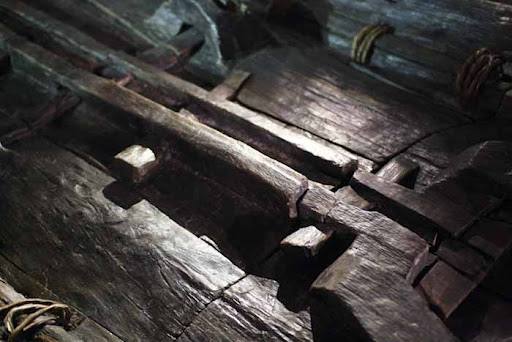


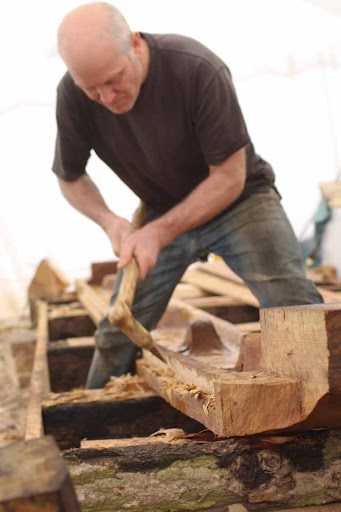
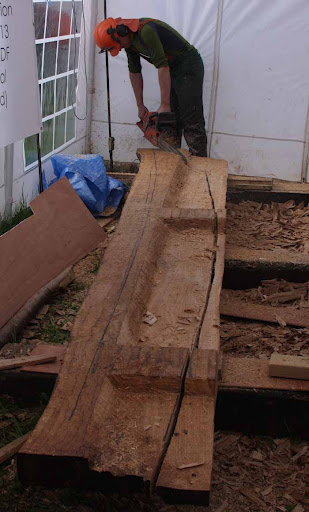
Here is Trevor cutting the joint between the two central base planks. In the original this seat was packed with moss and a lathe driven home tight over the top. The moss would expand as it got wet until it sealed. Because our replica is half scale and the lathe seat half as thick we don’t think that it will be possible to waterproof it with moss and for the sea trials we will use mastic then replace with moss when it goes on display in the museums.
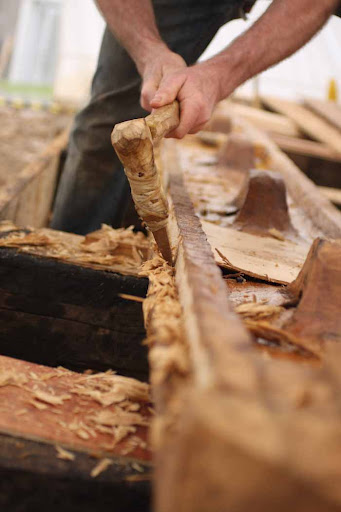
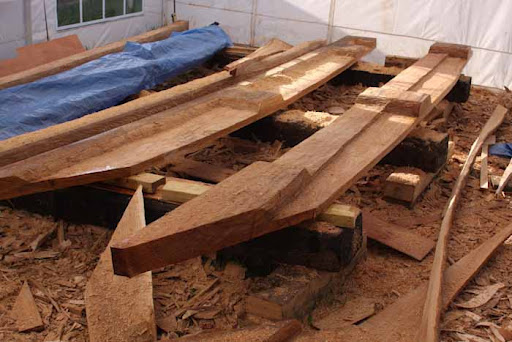
This shows the four bottom planks, there is much debate about how such complex boats evolved, they are so very different to the dugouts of the time and there is no parallel anywhere else in Europe. One theory is that they developed from the dugout canoe tradition. Bronze age and neolithic dugouts are surprisingly common finds no less than six have been found on a single site currently being excavated at Must Farm
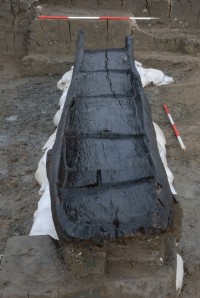
Some dugouts split and are repaired with laths and stitching, the theory goes that its not a huge step from there to cutting a dugout down the middle and putting an extra bit in to make it bigger, hmmmm.
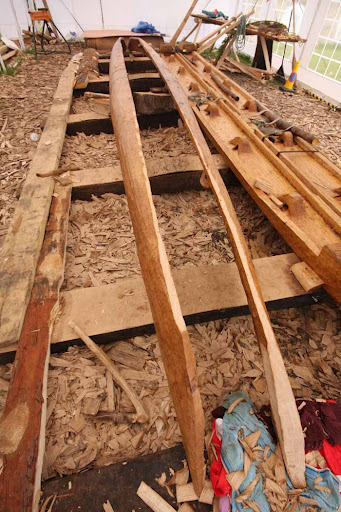
Anyway back to our boat, the next step is to get the upper planks ready, this needs us to assemble the boat and scribe the top line and transfer that line onto the rough hewn planks. Plywood makes this easy, wonder how they did it originally.
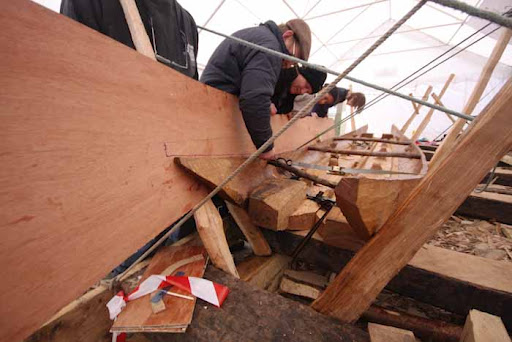
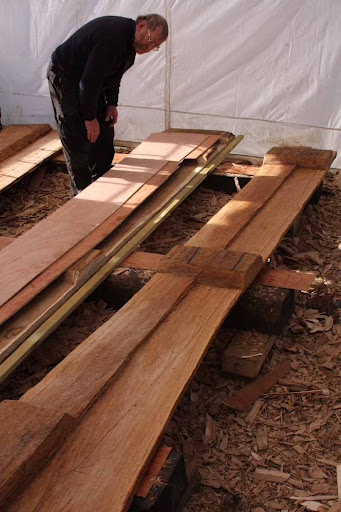
Then it’s time to cheat and rough it out with a chainsaw. We could hew all this away with bronze axes but it wouldn’t prove much and we are running behind time with a tight deadline, all the finishing will be done with bronze tools.
Roughed out top planks ready fro steaming.
Here is an index for all blog posts on the Dover boat project
bronze-age-woodworking-adzes-and-axes
more-bronze-age-woodworking
bronze-age-boat-building-pictures
bronze-age-boatbuilding-part-2
bronze-age-boatbuilding-part-3
bronze-age-boatbuilding-part-4
bronze-age-boatbuilding-part-5
bronze-age-woodworking-tools-early thoughts
building-bronze-age-dover-boat-part-6
building-bronze-age-dover-boat-part-7
boat-building-steaming-timbers
filming-with-time-team
more-bronze-age-boatbuilding.
casting-bronze-axes-and-adzes
more-bronze-age-boatbuilding.
20-hour-woodworking-marathon
woodworking-marathon-continued-just 18 hours to go.
dover-boat-launch-day-end-of-3-months work.
the boat-that-didnt-float.


Hi Robin,What an amazing piece of history! I'm curious about that wedging mechanism you mentioned – could you maybe explain a bit about how that works?
Well we don't know how well it works until we put it in the water but basically you can see in the photos at the edge of the two timbers are upstanding rails, these have tenons cut through and wedges banged through the two rails. The wedges must exert pressure sideways not upwards or they would split the rail. If the wedges were driven in parallel then they could pull apart again but if they go though at slight ang'les to each other they lock. Thats the theory……
So there are two opposing wedges to draw in both sides? Its a bit tricky to tell in the photo – seems quite ingenious!
Not opposing as in going in from opposite sides. Imagine the two outer legs of a W each being a wedge once driven through slightly angled together like that the central rail can not come apart. As I say all theory for now, in 3 weeks I can let you know if it works.
another great post on an incredible project…i'm anxiously awaiting the view of the transom ends or what have you that fills the void on the ends of the boat.
We did the model of those in polystyrene and I rough cut them last thing Friday night before leaving site but afraid I don't seem to have done photos so you'll have to wait a couple of weeks until I am back home.
People have been using various preparations of tree sap, especially kinds of pine resin, for tens of thousands of years as a glue and whatnot. I wonder if part of the recipe for the original moss caulking was also some kind of pine resin or even a version of pine tar, which is still used today for the purpose. I can understand why you'd want to go with the mastic on a maiden voyage for the cameras, but I have a hard time believing that a carefully fitted and well-dried batten wouldn't swell to fill that joint in a couple of hours.
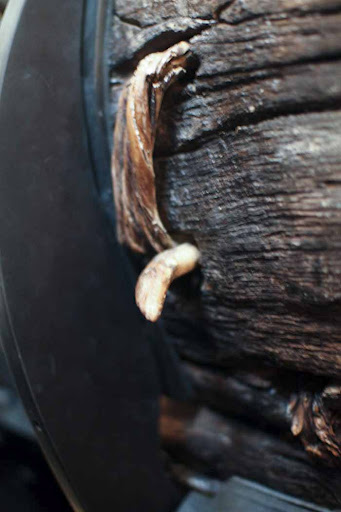
Hi Brian, Yes a mix of pine resin with animal fat to make it pliable would seem a good option and you are right it has been used for year, hundreds of years but this boat is a whole different order of age, it was abandoned 1500 years before the Romans arrived, 3000 years before the Mary Rose sank. The moss is very well preserved and there was no animal fat or resin included in the mix. Some beeswax was used to seal the stitch holes.With any experimental archaeological project you have to choose which aspects you are going to test. It would be great to test the moss+lath seams in sea trials too but that was not included in the remit of this project, and I am just there to carry out the vision not to try to change the brief.
Hi Robin, If there were no traces of resins then that answers my question. I don't know how long pine tar as such has been in use, but remember reading odds and ends of articles about traces of tree resin and tar being found on the bases of stone spear points far older than the boat. And the Native Americans used a pine-based pitch to seal the seams on their birchbark canoes, though thinking about it that might have been a European-influenced innovation as I don't think any really old boats have survived. But anyway it didn't seem an unreasonable idea. Crazy cool project.
I see your point on the testing. I managed to get in a couple of days working on a 14th century Loire River workboat that a trad-boat club was building in the Touraine a couple of years back. It was based on archaeological remains and a naval architect and historian from the French national maritime museum drew the plans to see how the boat worked. The guys used sawn planks when the originals were almost certainly riven, and power tools because they were working Saturdays only. They took some grief over the power tools sometimes, but always pointed out that the idea was to test the boat, not 14th century woodworking methods, so kind of the same thing, but on the opposite tack from the dover boat project.